Writing
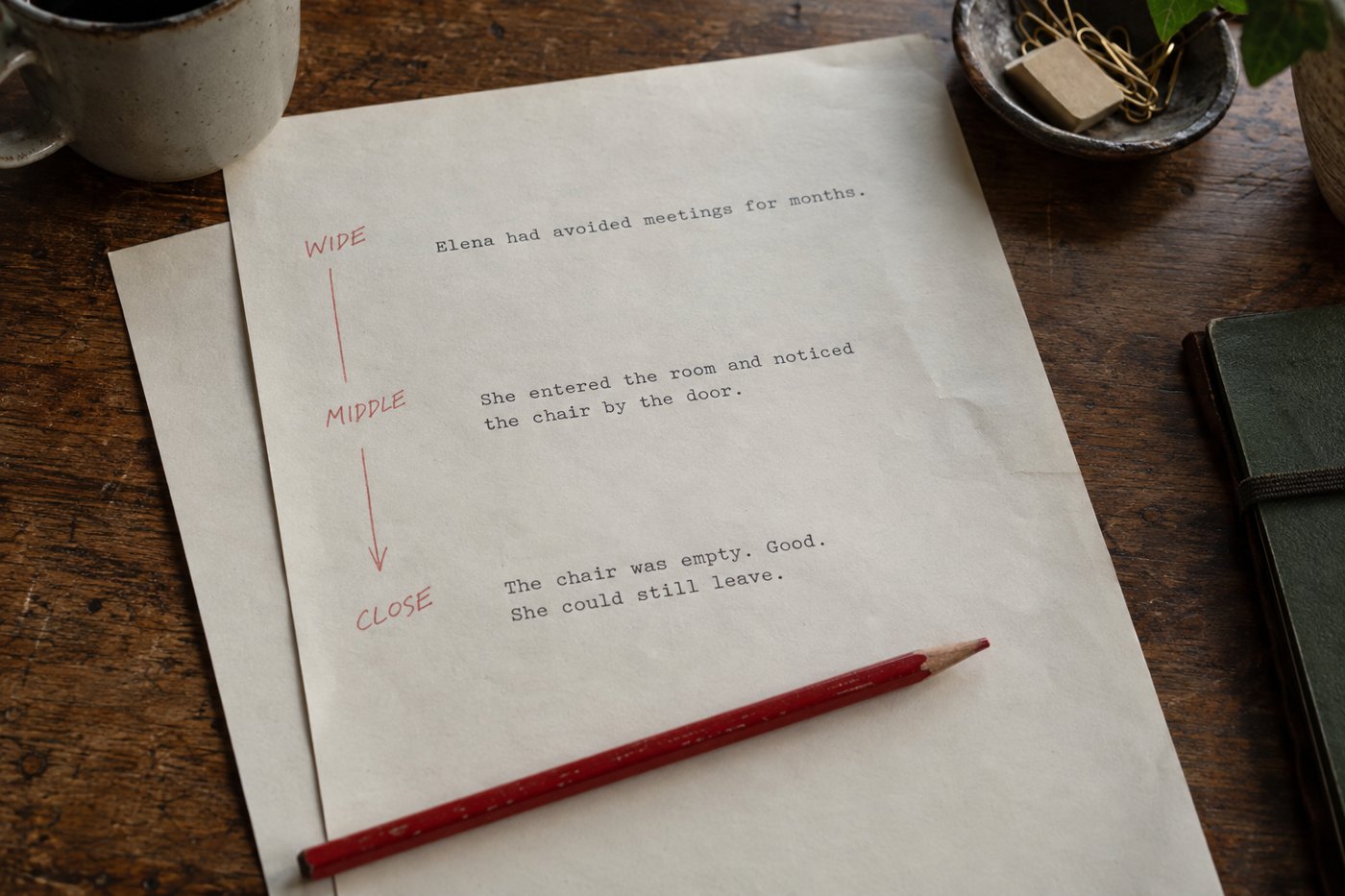
Moving closer to a character without changing viewpoint
Narrative distance changes the reader’s closeness to a character’s experience while the viewpoint can remain the same.
Writing
First person gains force from a clear boundary between observation, inference and knowledge.

'I knew she was lying' may describe a narrator's certainty, but it does not establish that the other person lied. First-person fiction can use this gap between conviction and fact. Trouble begins when a draft gives the narrator direct access to another person's thoughts without explaining how that information became available.
Read a scene for statements about other minds. 'He regretted coming' could become 'He kept his coat on and watched the door.' The second version supplies evidence from which the narrator and reader can draw conclusions. You can keep the interpretation too: 'I took that to mean he regretted coming.' The small qualification tells us whose judgment we are hearing.
The limit also applies to events beyond the narrator's presence. A first-person character cannot report a private conversation word for word merely because the reader needs it. Someone might recount it later, a recording might exist, or the narrator might imagine what happened. Each route produces a different degree of reliability. Make that route clear enough for the reader to assess it.
A narrator telling an old story may know things the younger self did not. 'I did not learn until winter that the letter had reached him' openly introduces later knowledge. A scene written as immediate experience should not quietly borrow that knowledge whenever the plot needs an explanation. Choose when the older voice enters and let its presence be recognisable.
You can check this on a simple page divided into three columns: what the narrator observes, what they infer and what they learn later. Place questionable statements in a column. If a sentence fits nowhere, it may belong to the author's planning notes rather than the narration.
Do not strip the voice of confident guesses. People misread tone, invent motives and turn fragments into stories; such habits can define a narrator. Preserve the distinction between a character's belief and the book's established facts. That distinction lets readers participate. They can notice the untouched tea, the evasive answer or the missing signature before the narrator understands what it means. The limitation then becomes a source of narrative interest instead of an obstacle to work around.
Writing
Narrative distance changes the reader’s closeness to a character’s experience while the viewpoint can remain the same.

Writing
Dialogue becomes active when people want different things from the same conversation.