
Editing
Copyediting and proofreading are different passes
Choose an editorial pass by the state of the manuscript and the decisions that remain, then describe the required work explicitly.
Editing
Record the choices that are specific to the manuscript, with enough context for someone else to apply them consistently.
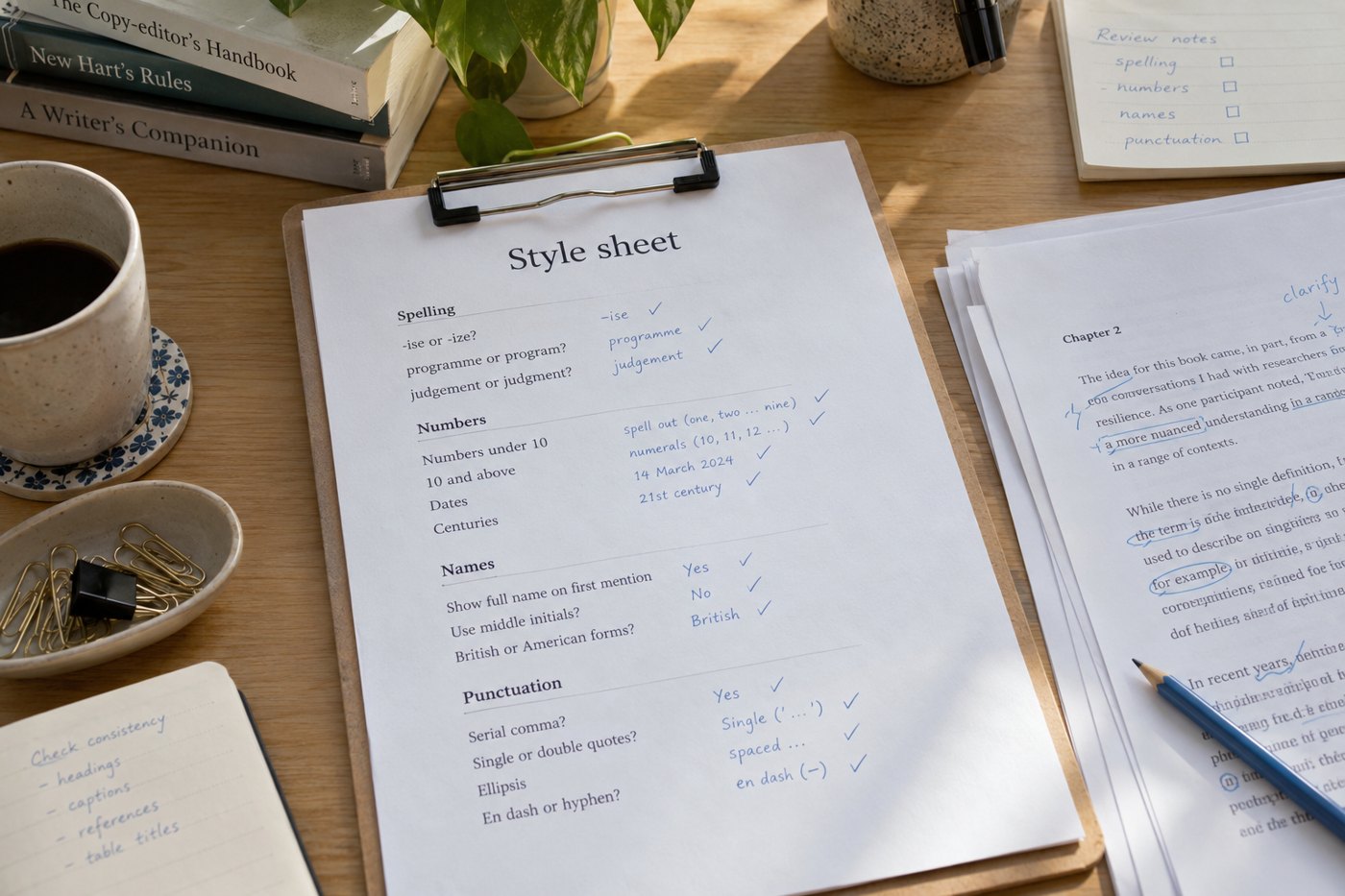
A style sheet is most useful when it answers questions that arise in the manuscript. It might record a preferred spelling, the treatment of dates, a character's full name or the format of recurring labels. The CIEP recommends keeping a record of editorial decisions, including spelling, capitalisation and hyphenation, and handing it over with the work.
Start with a simple document that can grow. Give it the project title, a date or version identifier and the name of the manuscript version it accompanies. If the work follows an agreed dictionary or published style guide, identify the reference precisely enough to avoid ambiguity. Record project-specific choices and exceptions rather than copying a whole reference book into the sheet.
Read a representative portion of the manuscript and note decisions as they arise. An introduction alone may not reveal the spelling of technical terms, the treatment of dialogue or the conventions used in appendices. Add sections when they become useful, and keep empty categories out of the way.
An entry should state the choice and show its scope. “Numbers in words” is too vague if the book contains measurements, dates, tables and dialogue. A more useful entry might say that small whole numbers in running narrative are written as words, while measurements and table values use numerals. The exact decision depends on the project; the point is to make the boundary visible.
Include an example when wording alone could be misunderstood. If chapter headings use sentence case, show a representative heading. If a term takes a hyphen in one grammatical position, record that context. A short example can prevent several rounds of interpretation later.
For an illustrative memoir, a names section might distinguish “Aunt Jo” in family dialogue from “Josephine Vale” in a formal record. That does not mean every variation should be removed. The sheet can preserve an intentional difference and explain where each form belongs.
Separate general conventions from individual entries. A reader looking for a place name should not have to scan a long paragraph about punctuation. Alphabetical lists work well for names and terms; short topic sections can hold broader decisions. Use the simplest arrangement that makes recurring questions easy to answer.
Consistency should serve meaning. A quoted passage may retain a spelling that differs from the surrounding prose. A character may use an informal name that other characters avoid. Record deliberate exceptions where someone might otherwise “correct” them away, and identify the relevant passage when necessary.
Keep unsettled matters visibly separate from approved decisions. An entry marked “query: author to confirm whether the two names identify the same person” should not look like an instruction to standardise them. Once the question is resolved, update the entry and note the agreed form. Avoid leaving contradictory instructions in different places.
A style sheet can also hold continuity details when they help the edit, but consider how much belongs there. A short list of characters, relationships and recurring locations may be useful. A sprawling collection of plot notes may be easier to maintain as a separate continuity document. Link or identify that document clearly so the reader knows where to look.
Do not record unsupported assumptions as facts. If the manuscript gives two birth years, the sheet can flag the inconsistency and its locations. It cannot determine which year is correct simply by choosing the one that appears more often. Establish the answer through the appropriate source or author query.
Update the sheet when a decision changes. If you switch a recurring term, search the manuscript for the old form and inspect the results in context. A global replacement can alter quotations, unrelated words or intentional exceptions, so the decision still needs careful application.
Before handing over the work, remove obsolete instructions, resolve or label open questions and check that the sheet describes the version being delivered. Include it alongside the manuscript, with a short note identifying anything that still needs attention. Someone receiving the files should not have to infer which document is current.
The sheet should reduce repeated decisions during later editing and proof checking. If it becomes difficult to navigate, reorganise it around the questions people actually ask. A concise record of clear choices will usually serve the project better than an impressive-looking document full of rules that never occur in the book.
Try one final usability check: choose a few unusual terms or recurring details from the manuscript and see whether the sheet lets you determine their treatment quickly. Where it fails, improve the entry or remove unnecessary complexity. Its value lies in helping the next reader make the same informed decision.
Editing
Choose an editorial pass by the state of the manuscript and the decisions that remain, then describe the required work explicitly.
Editing
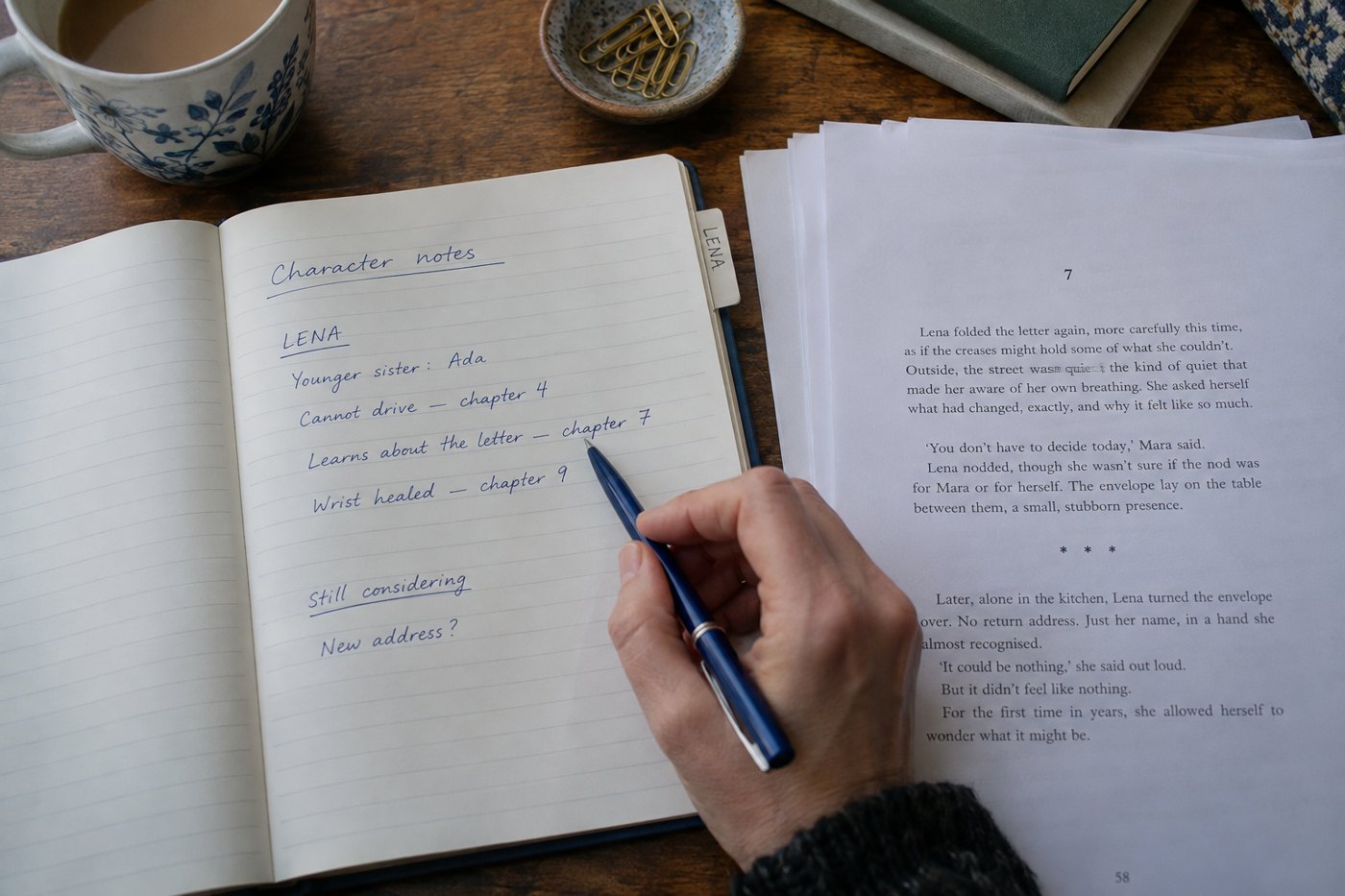
A small continuity record can save a long search. Record the details that constrain later scenes, rather than everything you know about the cast.