
Editing
Answer an editor query without losing the decision
An editor needs an answer that can be applied to the manuscript. Make the wording, location and final decision clear, especially when a query has several parts.
Editing
A considered review preserves the reasons behind an edit and leaves a readable, agreed manuscript.
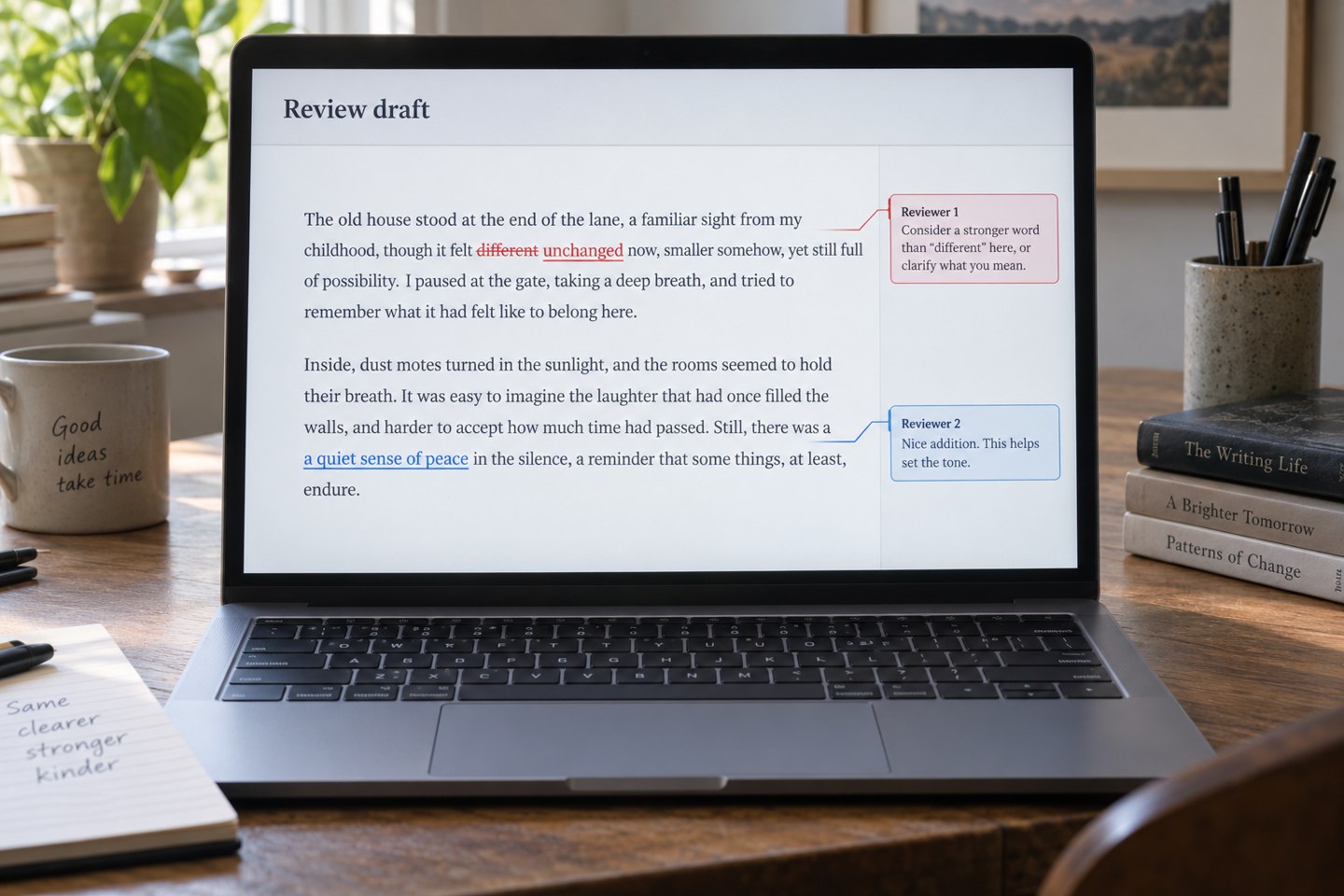
A heavily marked manuscript can make every sentence seem unsettled. Before deciding whether a particular change is right, save the editor's returned file unchanged. Make a separate review copy with an unambiguous name. Keep the editorial letter, style sheet and any accompanying questions together with it. The unchanged file is a record of what was proposed, not another working version to maintain alongside your own.
Read the editorial letter before working through individual marks. An editor may have shortened repeated explanations, regularised a character's name or changed a recurring construction for a reason discussed there. Seeing that pattern prevents you from treating a hundred connected decisions as a hundred unrelated surprises. Note any overall recommendation you need to discuss before accepting edits that depend on it.
Agree how replies should be recorded. You might answer queries in comments, leave disputed changes unresolved, or return a short list of questions. Combining all three without a convention can conceal decisions. If an editor asks for one reviewed file, keep that file authoritative while you work; do not also send replacement paragraphs in scattered messages.
Begin a passage by understanding what it would say with the proposed changes applied. Then inspect what changed. In Word, changing the display to hide markup does not accept the edits. Microsoft's guidance distinguishes the displayed view from the underlying revisions. Use the view that helps you read, while remembering that the decisions still need to be recorded.
Check meaning before polish. Replacing “may contribute to” with “causes” looks like a small cut but strengthens a factual claim. Changing a pronoun can alter who performed an action. In fiction, a smoother line may reveal information the viewpoint character does not yet possess. These changes deserve attention even when the new sentence sounds better in isolation.
You do not need to defend every original word. Ask what the proposed version gains and loses: clarity, pace, precision, humour, ambiguity or rhythm. If both versions miss the intention, write a third. Explain a significant alternative briefly, especially when the editor cannot infer the underlying fact from the manuscript.
A chapter or short section makes a more useful review unit than an arbitrary target of several hundred changes. Start with clear corrections whose purpose you understand. Then address edits that affect voice or argument, followed by queries requiring research. Keep a short queue for questions you cannot settle immediately, so one missing date does not stop the whole review.
Recurring decisions deserve a small record. If you retain a regional expression, choose a spelling or establish how a technical term is introduced, add that decision to the style sheet. Before accepting a repeated substitution throughout the book, inspect several contexts, including headings, quotations and dialogue. The same sequence of words may serve different purposes in different places.
Bulk commands require a known scope. A filtered display can show only particular reviewers or types of change, and software commands may distinguish visible changes from all changes. Read the command label and check the result on your working copy. Convenience should follow a decision about the text, not make that decision for you.
Once a section is resolved, read it without the visual noise of revisions. A deletion can leave a stranded reference; two individually sound edits can produce an awkward join. Pay particular attention to transitions, lists, paragraph openings and references such as “as noted above”. Those connections are easier to miss when reviewing one marked word at a time.
Before returning the manuscript, inspect remaining comments and changes deliberately. Unresolved items should be intentional and easy to find. A brief handover note can distinguish agreed decisions from questions still requiring an answer. Keep the original returned edit, your reviewed version and the later agreed manuscript as separate milestones. That small archive makes it possible to understand a decision without reopening every sentence for debate.
Editing
An editor needs an answer that can be applied to the manuscript. Make the wording, location and final decision clear, especially when a query has several parts.

Editing
Conflicting feedback becomes easier to use when you separate a reader’s experience from their proposed repair.